
Competitor fact table and price ladder: one set, one MAT, one price basis
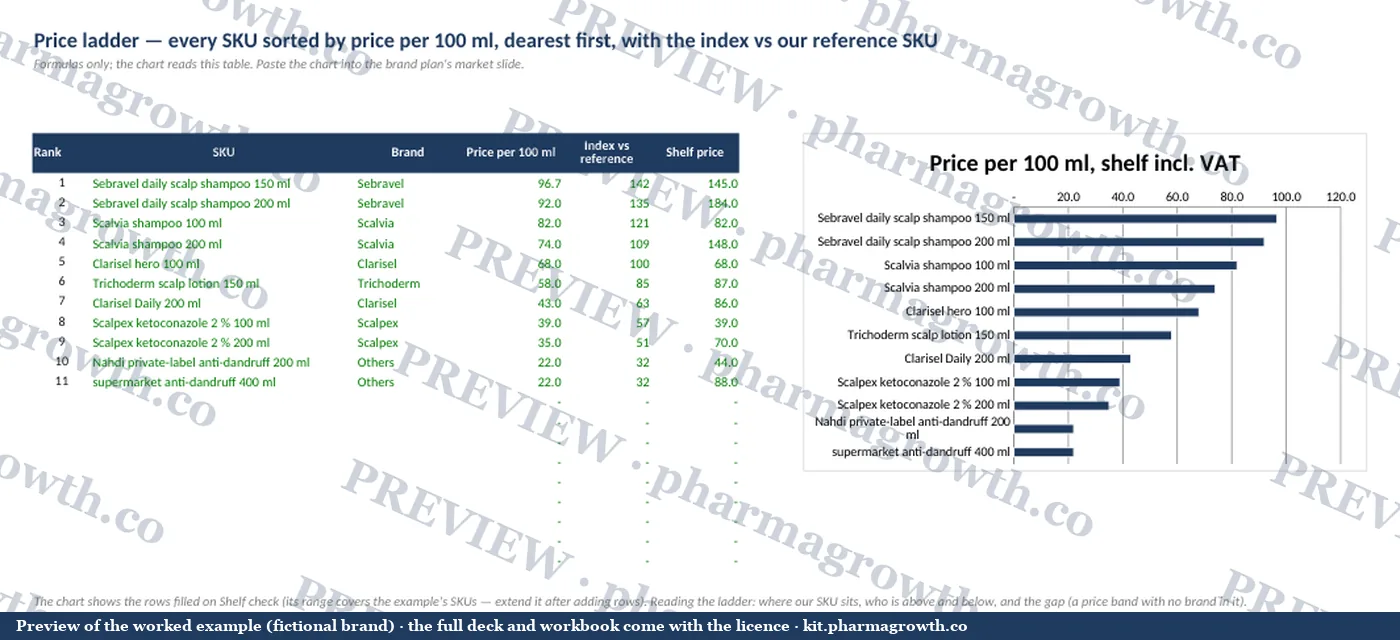
A workbook that keeps the competitor facts a plan needs — owner, class, lead SKU, price per 100 ml, index vs ours and vs the leader, share and its change, growth, rank — with the shelf check that builds the price ladder, the tier map (price tier × channel, one cell per brand), the share view and a watch list with triggers.
What you will have written when you finish
- 1The set, defined once: which brands and SKUs, on which MAT, on which price basis
- 2The fact table: pack, price, class, holder, distributor, claims, for every competitor SKU
- 3The shelf check, chain by chain, as of a date
- 4The price ladder that shows where every pack sits against yours
- 5The share view over the last four quarters
- 6The watch list: what triggers a response, and who watches it
4 sheets from the example workbook
A workbook that keeps the competitor facts a plan needs — owner, class, lead SKU, price per 100 ml, index vs ours and vs the leader, share and its change, growth, rank — with the shelf check that builds the price ladder, the tier map (price tier × channel, one cell per brand), the share view and a watch list with triggers.
Brand manager, category manager, business-development lead in consumer healthcare, writing for a Gulf market and presenting to a regional or global team. Also the distributor marketer who co-writes it.
Prescription brands with a medical-affairs plan, agencies pitching creative work, or anyone who needs a company's proprietary template.
Also useful with this workbook
Read next on pharmagrowth.co
Every item includes
Three working sessions on your own document: inputs and numbers, the draft, and a review against the questions management will ask.
Every example is set in one fictional world: Meridian Consumer Health, its distributor Northern Gulf Distribution Co., the scalp-care brand Clarisel and its competitors Scalvia, Sebravel, Scalpex and Trichoderm. Nahdi, Al-Dawaa and United are real Saudi pharmacy chains used as market fixtures with invented figures, as are the marketplaces, the quick-commerce apps and the discounter named in item 08. You see every box filled, every chart populated and every number reconciled, without a real company's data.